Your Feelings Can Be Wrong

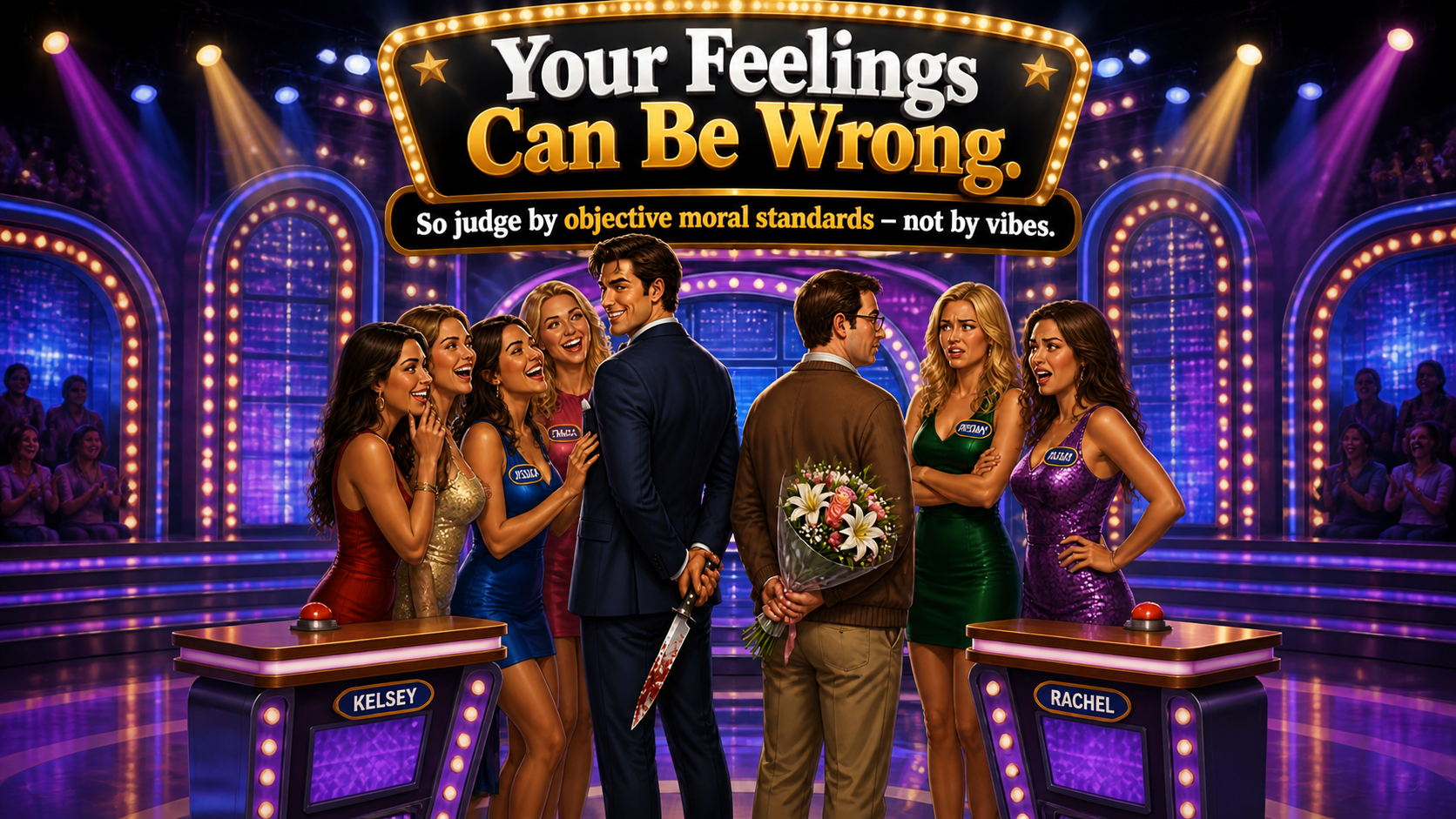
"Your feelings can be wrong." That sentence alone is a direct attack on one of the central dogmas of our current culture: that emotions are always telling the truth, and that the highest wisdom is to “trust how you feel.”
In practice, this dogma produces absurd results. I’m often told that people don’t “feel safe” around certain people—and that this alone is enough to condemn them. But feelings are very poor judges of moral character. Moral character can only be judged by the choices a person makes, not by how you feel when you look at them or talk to them.
Bad people can come off as good by knowing the right combination of things to say, and being willing to deceive. Or by wearing expensive clothing. Or by having others’ respect. Or social status. Or by being hot. There are cheaters and scoundrels who can win you over with their charm and etiquette. There are gruff car mechanics who cuss in every sentence, but would rather drive off a cliff than cheat a customer.
If you vote for politicians based on how good you feel when you think about them, then you’ve let money decide your vote. The more money a candidate has, the more and better marketing they can afford, and the better they can make you feel. Judging people’s moral character solely on how they make you feel is a road to destruction in more ways than one.
Every man who ever abused or unceremoniously abandoned a woman “came off as” sweet and empathic and… “safe” in the beginning. The women who date them had feelings about their safety—and their feelings turned out to be wrong. Whoops.
Once you accept that your feelings can get moral character wrong in these obvious cases, you have to accept that they can get moral character wrong anywhere. That’s the principle.
Now let’s apply that principle to me. I’m often told that people don’t “feel safe” around me, even though I’ve never started violence with anyone in my life, ever. I have never started a physical fight. I’ve never used a gun; I wouldn’t even know how to load one. I’ve never physically assaulted anyone. I’ve never hurt anyone. I am respectful and logical toward everyone, and compassionate toward those who suffer.
Recently, someone told me, “You say you care about everyone but your energy toward them doesn’t come off as care. Neither do your actions.” Come off as being the key phrase. All sorts of people “come off as” people they’re not. The fact that I don’t “come off as” care to someone says more about their interpretive filters than it does about my actual intentions.
Where does their “unsafe” feeling come from if there is no actual danger? It comes from cognitive dissonance. I cause people to feel cognitive dissonance because I expose the wrongness in their beliefs. Wherever I go, lies get exposed. Moral inversion gets exposed. Hypocrisy gets exposed. I’m a walking truth machine. Hang out with me long enough and you will find two or more of your beliefs coming into conflict with each other—beliefs that were always in conflict, but that you never noticed until someone pointed it out.
That clash—belief against belief, illusion against reality—feels bad. The nervous system doesn’t label it correctly as “epistemic discomfort”; it just says, “I don’t feel safe.” The feeling of cognitive dissonance is mistaken for a feeling of physical danger. So people who have no reason to feel in danger from me nevertheless feel unsafe. They feel unsafe around someone who is actually safe, whose “danger” is simply that he won’t let their contradictions stay hidden.
In other words: their feelings are wrong. They feel unsafe with someone they are safe with, just as they feel safe with people who turn out to be abusers or exploiters. Same principle, different direction.
The principle applies to dating and mate selection as well.
If a man can make you feel safe and then abuse you, then it is entirely possible that another can make you feel unsafe while being of a spirit to love and serve and worship you, loyally, forever. If one pole exists, so must the other.
He might just be shy. Nervous. Awkward. And since his nervous system is nervous, he makes yours nervous too—or “unsafe,” or “unregulated.” But it’s not because he’s a bad or dangerous person. He’s just nervous, for godsake. Women make men nervous. Men have to control a huge flood of emotionally charged and often confusing energy the moment they’re near women. And the more he reveres her as divine (the way they all say they want men to), the more nervous she makes him. Nervousness correlates with reverence.
So if you dismiss men for being nervous—because their awkwardness makes you feel bad when interacting with them—then you have set up a systemic policy of only allowing the irreverent to come near you, and distributing your energy and presence to men in inverse correlation to how much they revere you. The result: “fuckboys” pumping and dumping you. They didn’t see the value in you, your divinity, the goddess in you. So they used your body for a little while and then threw you away.
And you got with those types of men in the first place because you were selecting for nervous system regulation—for men who make you feel “regulated” immediately. Those men can avoid making you nervous because they themselves are not nervous—because they do not revere you. You ignored and dismissed the men who did revere you, because their reverence made them nervous and awkward around you.
Once you see how feelings can misread mechanics, politicians, abusers, nervous lovers, and truth‑tellers, you start to realize that feelings are terrible instruments for judging morality. They are exquisitely good at registering comfort and discomfort. They are terrible at telling you whether you are dealing with a good person or a bad person.
If you build your social ethos on the founding premise that all feelings are true and that all decisions should be made based on feelings, then you have created a culture untethered from reality. You will select leaders based on which ones give you a warm glow—i.e., which ones can afford the most sophisticated marketing. You will select partners based on who can keep your nervous system placid—i.e., who is least reverent and most practiced at performance. You will surround yourself with people who never make you feel uncomfortable, and you will drive away anyone who challenges you.
And here is the crucial point: good choices can make you feel bad. If you were the one in the wrong, then accountability will feel awful. Being confronted with your own hypocrisy, your own moral inversion, your own lies, is not a pleasant experience. If you set up a policy of systematically ejecting anyone from your awareness whenever they make you feel bad, then you have precluded the possibility of anyone ever holding you accountable for anything.
Accountability always feels uncomfortable. So if “I feel bad” automatically means “you’re a bad person and I’m ejecting you,” you have built a self‑sealing system that protects you from all correction. That is how a culture slides toward sociopathy: it enshrines comfort as the highest good and declares any source of discomfort to be morally evil by definition, regardless of whether the discomfort came from cruelty or from truth.
None of this means feelings don’t matter. They do. Emotions are not trash to be thrown out; they are witnesses. They tell you that something is happening inside you. They tell you that something in the environment matters to you. They tell you that your body and psyche are responding.
But witnesses are not judges. Just because you feel an emotion doesn’t mean you have found truth. You must allow for the possibility that your feelings can be wrong about stuff. If you don’t, you will never adjust your map of reality, because you will take every sensation as a verdict.
Emotions are powerful testimonies; they are not verdicts. You should listen to them and treat their promptings seriously. You should ask, “Why do I feel unsafe?” “Why do I feel drawn to this person?” “Why does this politician make me feel hopeful?” But you must also use reason to interpret them, to check them against facts, history, patterns of behavior, and actual choices.
Your feelings can be wrong. That’s not an insult; it’s a liberation. It means you are allowed to revise your impressions. It means you are allowed to realize that the person who made you feel safe was actually dangerous, and that the person who made you feel unsafe was actually the one telling you the truth. It means you are allowed to grow.