You’re Weaponizing “Boundaries” To Avoid Accountability

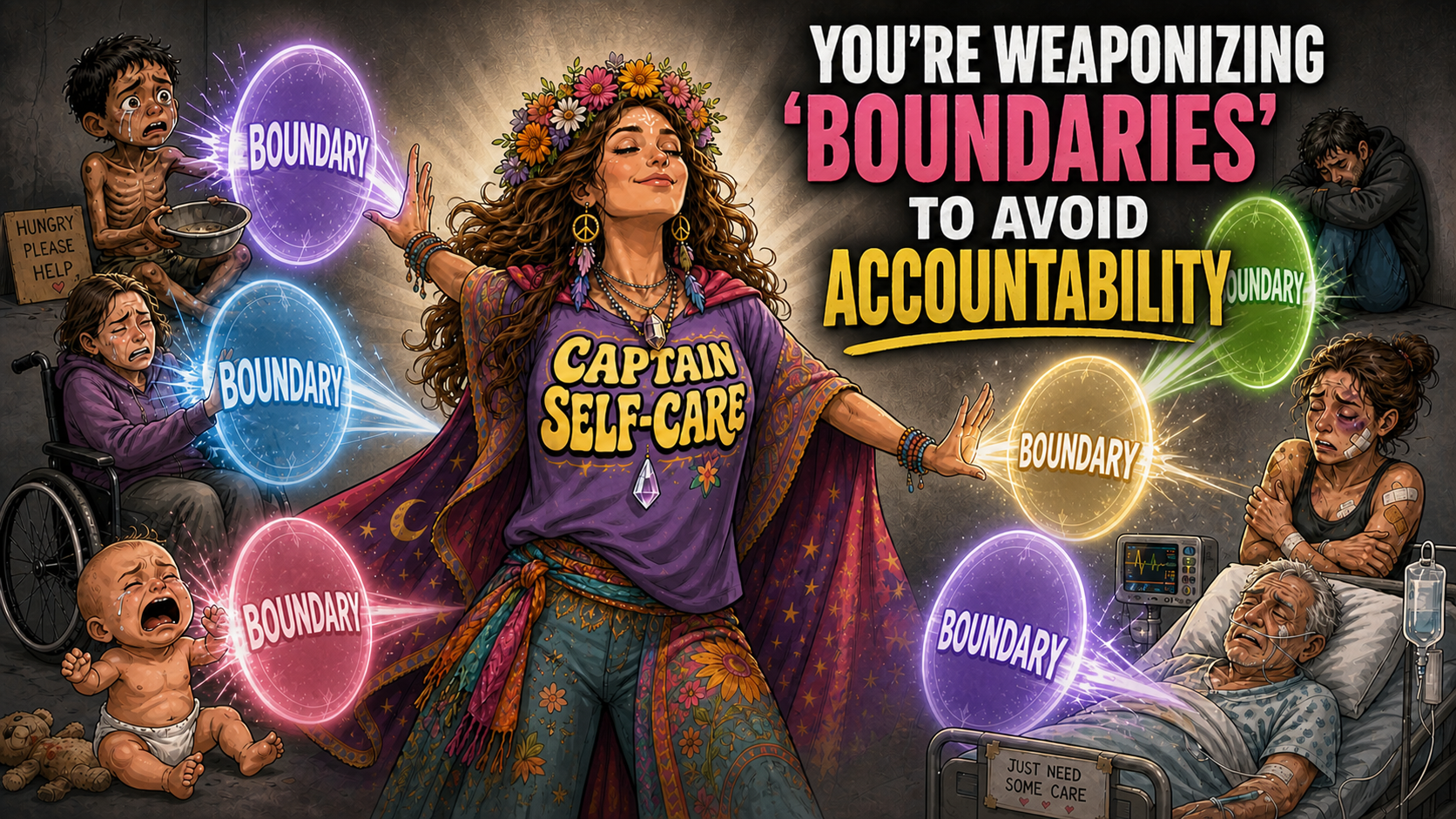
There is a new kind of censorship in the world, and it doesn’t wear a badge or carry a ban‑hammer. It wears mala beads and speaks softly about “safety” and “self‑care.”
It lives in statements like:
- “I need to honor my boundaries.”
- “Your energy feels toxic.”
- “This doesn’t feel safe for my nervous system.”
And then, somehow... you disappear.
Underneath the gentle tone and the therapy vocabulary, the move is brutally simple: shut down the conversation, cut off the person, and feel morally justified doing it.
The New Heresy
This isn’t new in spirit. It’s just new in vocabulary.
- Medieval Christians called it blasphemy and heresy, and they shut people up by banishing or killing them.
- The modern censorship complex calls it misinformation, disinformation, and malinformation, and shuts the source up by banning and shadow‑banning.
- Today’s “conscious” people call it “toxicity,” “bad vibes,” and “boundary violations.” And they shut the source up through blocking, unfriending, cutting off communication, and social exile.
Same impulse, different words:
“This thing you are saying makes me uncomfortable. Therefore it is dangerous. Therefore I am justified in silencing you.”
What a medieval Christian would call “shutting up the heretic to protect myself from the wily tongue of the devil,” a modern conscious person calls “setting up a boundary to protect myself from emotional toxicity.”
It’s the same damned thing.

Conspiracy theorist. Anti‑vaxxer. Heretic. Blasphemer. “Toxic person.”
Misinformation. Disinformation. Heresy. “Bad vibes.”
All the same game: delegitimize the speaker so you never have to hear the content.
The Conscious Person’s Disease
There is a subset of people who are genuinely more awake than average in many areas of life — trauma‑aware, spiritually literate, into meditation, psychedelics, shadow work, somatics, all of it. We call them “the conscious community."
And precisely because they see themselves as more evolved, they are the ones most tempted to weaponize therapy‑speak.
If you identify as “conscious,” you have probably internalized the belief that no one should ever be angry at you. You’ve built an identity around being gentle, loving, nonviolent... “safe.”
In that identity, other people’s anger at you feels like an attack on your very essence. So you reframe it:
- “They’re projecting.”
- “They’re stuck in their shadow.”
- “This is abusive.”
- “This is a boundary violation.”
And once the label is applied, the solution is obvious: cut them off.
Block. Ban. Unfriend. Ghost. Push them to the farthest edge of your awareness, into that outer ring of “people I know exist but do not ever engage with.” That’s where other people’s anger goes.
Meanwhile, your own anger gets retreats, workshops, and sacred processing. You punch pillows and do primal screams and write letters you never send. You know that you’re not supposed to pretend your anger doesn’t exist.
Your anger is important to gain awareness of, and process.
But other people's anger?
No way. Not even for a split second. Not at all.
How convenient is it that other people’s anger becomes “ego toxicity” which you have the right to forcefully block out of your sensorium. How convenient that any sign of anger, no matter how tiny, can be treated as a sign that this person must be blocked immediately — do not let them speak, not one word, block, ban, aaaaah, right now.
How utterly fucking convenient.
You never have to experience being blamed for anything. You never have to hear a grievance against you. You never have to confront any mistake you may have made in how you related to someone. You never have to face the true nature of your own actions toward other people.
Anger Exists for a Reason
Anger is not just “negative energy.” It is a signal.
Human beings are designed with a fail‑safe mechanism that alerts us when harm has been done. That mechanism is anger — especially other people’s anger directed at us. When you’ve treated someone without compassion, without empathy, without honor — when you’ve been cruel, careless, or callous — nature has a way of bringing that to your attention. Their anger says: something you did was not okay. Look at it.
That is why the human being has this function built into it. Other people’s anger is often the message that brings your own cruelty to your awareness. It is the feedback loop that allows recognition, correction, and repair.
So if you train yourself to call that signal “toxicity” and block it out, you are cutting the wires to your own moral alarm system. You never have to look into the face of someone you’ve hurt. You never have to hear their account of what you did. You never have to confront your own mistakes, your own callousness, your own discrepancy of empathy.

You just label the alarm a “boundary violation” and forcefully shut it off.
You’ll say that “blame” is unenlightened, that no one should ever blame anyone for anything. But who is less enlightened: the person who blames, or the person who cannot even remain in conversation with someone who blames them, and weaponizes the language of nonviolence to commit emotional violence and flee?
You know the answer.
Negative Is Not Bad - It's Essential
People have quietly convinced themselves that they have a natural right to block out all “negativity,” and to decide for themselves what counts as negative. If a communication gives them bad feelings, they declare it “toxic,” “unsafe,” “not aligned,” and use that judgement as a moral license to shut the channel down.
If the receiver gets to decide whether a communication is “positive” or “negative,” and then claim the right to cut off any “negative” communication, the result is inevitable:
- you will only ever hear things you already agree with, because those feel good by definition;
- you will never hear anything you disagree with, because those feel bad by definition.

And then everyone lives inside sealed bubbles of agreement, surrounded only by voices that confirm their current beliefs — exactly like right now. Is it working? Is this ethos making humanity wiser, more harmonious, more sustainable?
Boundaries as Shields Against Knowledge
Used honestly, “boundaries” are about preventing ongoing harm. Used dishonestly, they’re about preventing incoming information.
If you call every uncomfortable truth a boundary violation, your “boundaries” become shields against knowledge. They block:
- evidence of how you’re hurting people,
- testimony about the impact of your choices,
- and the cognitive dissonance that might force you to change.
You can go on hurting people, because you’ll never look at the evidence. You’ll never have to self‑reflect or update a belief, because you’ll never confront the data that says you should. It’s the perfect one‑size‑fits‑all shield against accountability, now and forever.
The Gender War Supercharges This Pattern
There’s another layer that makes this worse, and it lives especially in “conscious” circles.
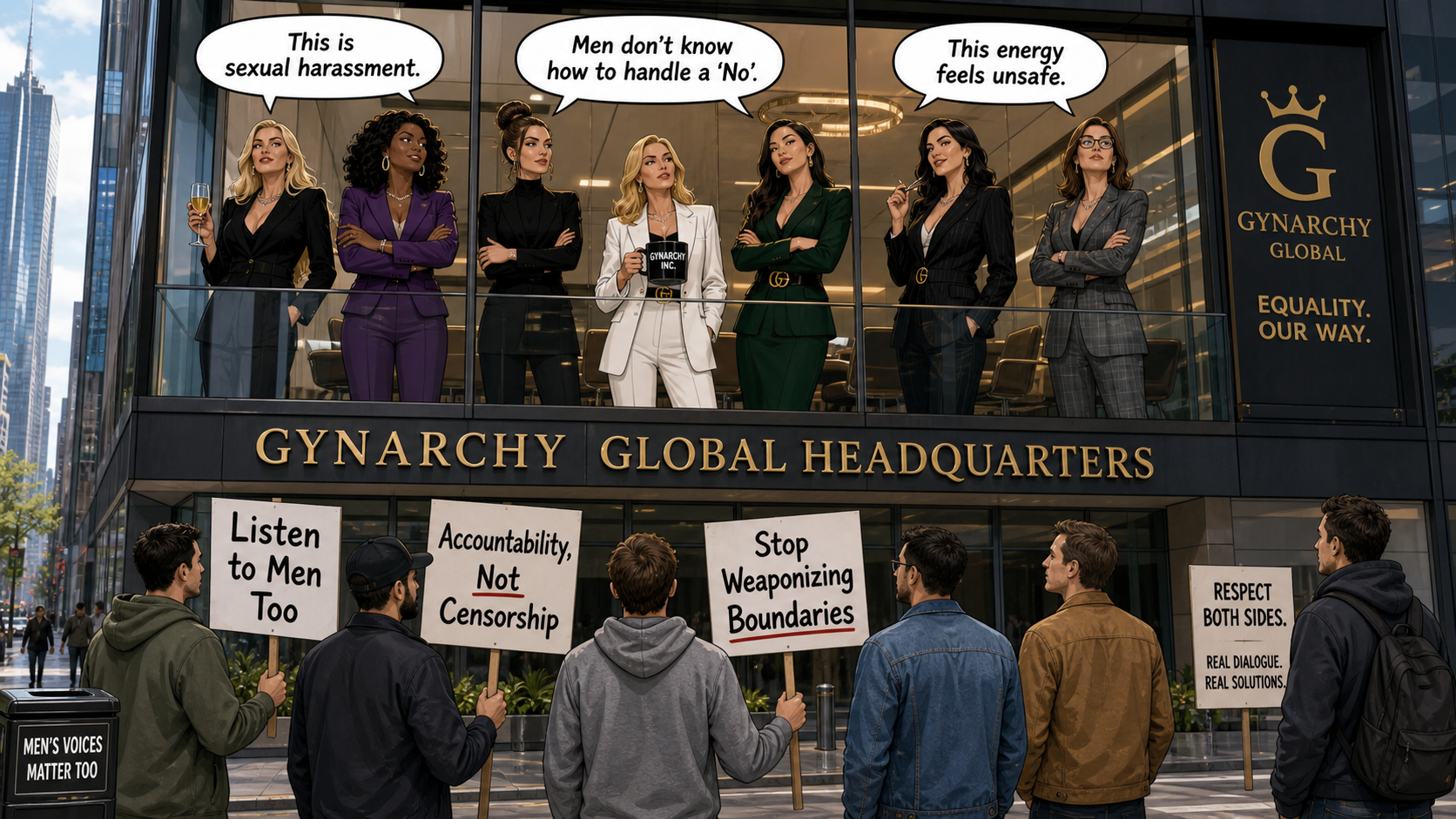
While it can happen between any demographics — any race, gender, age, body type — it is vastly more tolerated when it’s being committed by someone female against someone male. If you’re a woman, you have an extra shield on top of therapy‑speak: the language of sexual harassment and “predatory energy.”
The emotional dynamic of male‑female romance bleeds into every context. Any man who challenges you intellectually can be treated as a potential predator, simply because he’s male and you’re uncomfortable.
The feeling in your stomach when your beliefs are being exposed as wrong — that cognitive dissonance — is easy to mislabel as physical danger. Intellectual danger masquerades as bodily threat. The more of an intellectual coward you are, the more tempting it is to let that confusion stand.
So the move becomes:
“This man is making me feel unsafe. Therefore he’s crossing sexual boundaries. Therefore I can expel him.”
Your community will cover for you. Conscious spaces have quietly become gynarchies: women as upper class, men as lower class. Upper classes get extra rights. They can dehumanize lower‑class members with fewer consequences, especially when cloaked in the language of “safety” and “trauma awareness.”
And in doing this, you pollute the very language that genuinely traumatized women need to describe real harassment and assault. You dilute “harassment” and “boundary violation” until they mean “any situation where my ego is being challenged.” That makes it harder for real victims to be heard.
All to protect a fragile self‑image from being wrong about something.
Why I’m Singling Out Conscious People
If you call yourself “conscious,” you’ve claimed higher ground than the unwashed masses. That’s not inherently bad — hierarchies can be fine when superiority is earned through actual moral courage.
But if the self‑described conscious crowd is just as censorious, just as avoidant, just as allergic to disagreement as everyone else — only more smug about it — then the prognosis for humanity is grim.

It’s one thing if Joe Sixpack can’t handle an honest conversation. It’s another thing entirely if the yoga‑meditation‑psychedelic‑shadow‑work crowd also can’t handle it, and instantly blocks and unpersons anyone who brings inconvenient information.
If even the people who talk nonstop about “shadow work” and “facing our shadows” are actually running from theirs, where is the example supposed to come from?
This cowardly hypocrisy has gone on long enough.
What Being Conscious Actually Requires
Being “conscious” does not consist of:
- using a lot of Sanskrit terminology,
- calling people “brother” and “sister,”
- talking in a high‑pitched voice,
- wearing crystals,
- producing dope‑ass beats,
- self‑righteously namaste‑ing at people,
- saying “Blessings” right before you dehumanize them.
Being conscious consists of having the courage and humility to consider the possibility that you might be wrong about shit, and therefore listening to others and dialoguing with them — especially with those who disagree with you.
Being conscious consists of honor: keeping your word and staying true to your professed principles. If you say you believe in free speech, open‑mindedness, and communication, then live according to that even when your feelings want otherwise.
If your feelings want to use therapy‑speak to shut down someone who’s bringing you information that proves one of your beliefs wrong, you have to overrule your feelings.
You can scream about the WEF, rail against tech censorship, and condemn governments for silencing dissent — and then, as soon as someone says something you disagree with, you censor just as hard and just as fast as any Trust & Safety team.
Stop using therapy‑speak to avoid introspection.
Stop pretending that a person who is proving you wrong about your beliefs is some kind of “danger” you must protect yourself from by blocking and banning. Stop citing “boundaries” as an excuse to make a person with inconvenient information disappear.
When you call someone “toxic” or “stuck in darkness,” there is no qualitative difference between that and any of the thousand playground slurs your grandparents heard. It’s the same bullying instinct in prettier clothes.

Either come up with a counterargument, admit you’re wrong, or say you need more time to think. Those are all honorable moves. Making the other person disappear is not.
The truth doesn’t vanish just because you hit “block.” It sits there, being true, whether you look at it or not.
If you want to be conscious, start there.