Hatred Is Not A Moral Failure


You're not a bad person if you hate.
What follows isn’t a defense of cruelty or random rage; it’s an anatomy of what anger and hatred actually are, what they’re for, and why the real villain almost never is the person who feels them.
1. Anger is not a moral failure; it’s a message
Anger exists for a reason. It is Nature’s way of letting us know when we have been hurt – and of letting others know when they’ve hurt us. Anger is more than raw information; it is an emotional phenomenon that wraps that information in intensity so people will actually pay attention to it. Information alone usually isn’t enough, because people don’t care about abstract “data,” but they do respond to emotion.
When you’re angry at someone, you’re angry because they hurt you. The anger is your nervous system raising its voice: Hey, this mattered. This cut deep. The tone, volume, facial expressions, and gesturing are there to broadcast the seriousness of the injury so the other person can grasp the gravity of what they did. The emotion says: not only did you hurt me, you hurt me badly, and you need to take heed.
This is kindergarten‑level psychology. Children already know how this works. You yank a toy, the other kid cries and yells, and everyone instantly understands there’s a problem. Somewhere along the way, adults forgot this and started pathologizing the very mechanism that keeps relationships honest.
That is why there’s only one real, healthy way to express anger. And it’s not punching pillows. It’s not primal screaming into the wilderness. It’s not venting to a third‑party friend or confidant. Those discharge energy, but fail to address the reason why the energy is there in the first place, and impede the performance of that energy’s natural function and raison d’être. The only expression of anger that fulfills its purpose is to tell the person who hurt you that they hurt you, and how they did so, and how it affected you, and why it was wrong.
Anger exists to carry a message straight to the person who caused the pain. If that message never reaches them, anger’s job is left unfinished. When a culture tells people that anger itself is shameful, “unevolved,” or “toxic,” it is literally dismantling one of the few remaining support beams holding relationships, communities, and the human race together.
Once you see anger as a message with a job to do, the next question is: what happens when that job is blocked for a long time?
2. From anger to hatred: when the message is blocked
So what happens when anger is never allowed to do its job? When it’s drained off into pillow‑punching, primal screaming, drugs, distractions, or “venting” to anyone except the person who actually caused the harm? At first, the pressure eases a little—but the underlying wound remains untouched. Over time, that unspoken anger doesn’t disappear; it crusts over. It ferments. And what began as a hot, living signal gradually hardens into hatred.
In anger, there is still a clear object: you did something evil. The focus is on the act—on the wound. But when anger is kept from fulfilling its function long enough—when every attempt at conversation is blocked, ghosted, mocked, or dismissed—the psyche shifts. The mind no longer sees the person as someone who did evil; it begins to see them as someone who is evil. The anger thickens into a more entrenched form: now it’s not just “you hurt me,” but “you are a piece of shit.”
And in many cases, that assessment is not wrong. If someone hurts you and then refuses every attempt at accountability, conversation, or repair—blocks you, evades you, invents excuses, and uses any tool available to avoid even talking about what they did—that’s not a misunderstanding. That’s cowardice and cruelty. The anger that was once trying to carry a message has been forced into exile, and what’s left is hatred: the solid, cold residue of a long train of injury plus systematic evasion.
Hatred, in this sense, is not the origin of the problem; it is the by‑product of a problem that has been denied the chance to heal. Wherever you see hatred, you are looking at anger that has been prevented from doing its work for days, weeks, years, or generations.

And if hatred is the scar tissue, then the infection underneath it—the thing that keeps wounds from healing—is not “too much feeling,” but something else entirely...
3. Apathy, not hatred, is the real moral failure
In almost every conflict, you can map the sides very simply. One party hates. The other party is apathetic. Side A burns with anger and hatred because it has been hurt, exploited, or oppressed. Side B shrugs, rolls its eyes, and wonders what the big deal is, insisting that it just wants to be left alone.
Side A is the one carrying the pain. Side A is the one trying to get a message across. Side A is the one whose anger is attempting to drag the conflict into the light. Side B wants none of that. It wants the benefits of whatever it is doing to Side A—whether that’s emotional exploitation, material extraction, or social abuse—without ever facing accountability for it. So it stonewalls. It refuses conversation. It blocks. It ghosts. It weaponizes social norms and “boundaries” to make sure the subject never comes up.
This is why apathy, not hatred, is the real villain. Hatred is built out of pain and failed attempts at communication; it is the scar tissue of a psyche that tried to speak and was ignored. Apathy is the deliberate refusal to care that someone else is in that state. Apathy says: Yes, I know you’re furious. Yes, I know you’re hurting. No, I’m not going to sit down and hear why. I have my lifestyle, my comfort, my fun, and your suffering is not worth the inconvenience of a conversation.
And because apathy shuts down dialogue, it also shuts down the only mechanism that could resolve the conflict. It stops anger from delivering its message. It forces anger to stagnate and harden into hatred. Whenever and wherever you see deep hatred, you are looking at the aftermath of long‑term apathy—the trail of “leave me alone,” “you’re too negative,” “you’re toxic,” and “I’m blocking you” laid down by the side that refuses to listen.
Recognizing apathy as the true villain flips the usual moral picture on its head—and it forces you to rethink what hatred actually says about a person’s character.
4. Hatred is proof you’re still capable of love
Our culture loves to say that hatred is the ultimate moral failure. It tells you that to be “evolved,” “enlightened,” or “spiritual,” you must never hate, and preferably never even be angry. But look at what that implies: that the correct attitude toward evil, injustice, and exploitation is emotional neutrality. That the highest spiritual state is to watch the world burn and feel nothing.
In reality, if you are not angry, you are probably not paying attention. There is so much abuse, manipulation, and destruction unfolding at every level of our world that a genuinely awake, empathic psyche cannot help but respond. Anger and hatred, in this context, are signs that you have not anesthetized yourself, that you are still capable of feeling pain—for yourself and for others—and that you still recognize threats when you see them. That is not the mark of a bad person. It is the mark of someone whose moral sensors are still online.
At the core of hatred lies love. You only hate because something you loved was violated: a relationship, a community, a potential future, a principle, a world that could have been. Hatred is love that has been deprived of any outlet—love that had nowhere to go, no relationship to inhabit, no shared reality to manifest in—until it congealed into a dark, dense form. The deeper a person’s hatred, the more you can infer about the depth of their capacity for love, because you have to be a creature of love in the first place to suffer that intensely from its absence.
That is why those who hate are often the very people most fiercely dedicated to justice. They have not given up. They have not numbed themselves. They continue to track the discrepancy between what is happening and what should be happening, between the world we have and the world that is possible. Hatred, in that sense, is not proof of moral collapse; it is proof of unyielding moral sensitivity. It says: I still care enough to be in pain about this.

If you want to end hatred, you cannot start by attacking the people who hate. You must start by attacking the conditions—and the apathetic behaviors—that created that hatred in the first place.
Of course, a system that rewards apathy and punishes sensitivity can’t admit any of this. It has to rewrite the story, and it does so by turning the emotional compass upside down...
5. How the angry get framed as the bad guys
Once you understand that anger and hatred arise from injury and blocked communication, the next layer of the problem becomes obvious: in most conflicts, the apathetic side also controls the story. They enjoy the social status and prestige, and the wealth. They wear nicer, more expensive clothing. They have access to slick marketing firms that can fortify their message with centuries of expertise in emotional manipulation. They own the platforms, and can censor dissident voices. They have the reputations, the halo effects, and the control over language. They decide which emotions are “acceptable” and which are “toxic.”
So a simple, disastrous heuristic takes root in the culture: whoever is angrier must be the wrong one. If you want to know which side is “good” and which side is “bad,” just look at who is furious, shouting, crying, and “making a scene,” and then assume that they’re the problem. Meanwhile, the side that is reclining, laughing, saying “I don’t know what their issue is, I just want them to leave me alone” gets coded as calm, sane, and therefore morally superior.

This is exactly backward. The angry side is almost always the side that has been hurt. Their rage is the emotional fallout of victimization. The “leave me alone” side is almost always the one benefiting from the arrangement—the one whose lifestyle, status, or comfort has been purchased on the backs or at the expense of others. Yet because that side controls media, institutions, and social narratives, it can portray its victims as the villains and itself as the innocent target of “negativity.”
Over time, the culture absorbs this framing. Anger is equated with “toxicity.” Hatred is treated as a moral failure. Anyone who insists on witnessing the evidence of evil long enough to feel something about it is branded as dark, negative, un‑evolved, and eviler than the evil they’re witnessing—just for witnessing it and feeling what any warm‑blooded human being is supposed to feel. And in that way, the very people most sensitive to injustice get pushed to the margins, while the apathetic beneficiaries of that injustice are celebrated as paragons of peace and “chill.”
The result is a civilization that punishes moral sensitivity and rewards moral numbness. The more you feel, the more you are shamed. The less you feel, the more you are admired. And the propaganda machine rolls on, insisting that hatred is the enemy, while quietly absolving apathy of all responsibility.
So if hatred is an honest response to real harm, and apathy is what keeps that harm in place, the question becomes: how do we actually move forward?
6. Dialogue: the only medicine for hatred
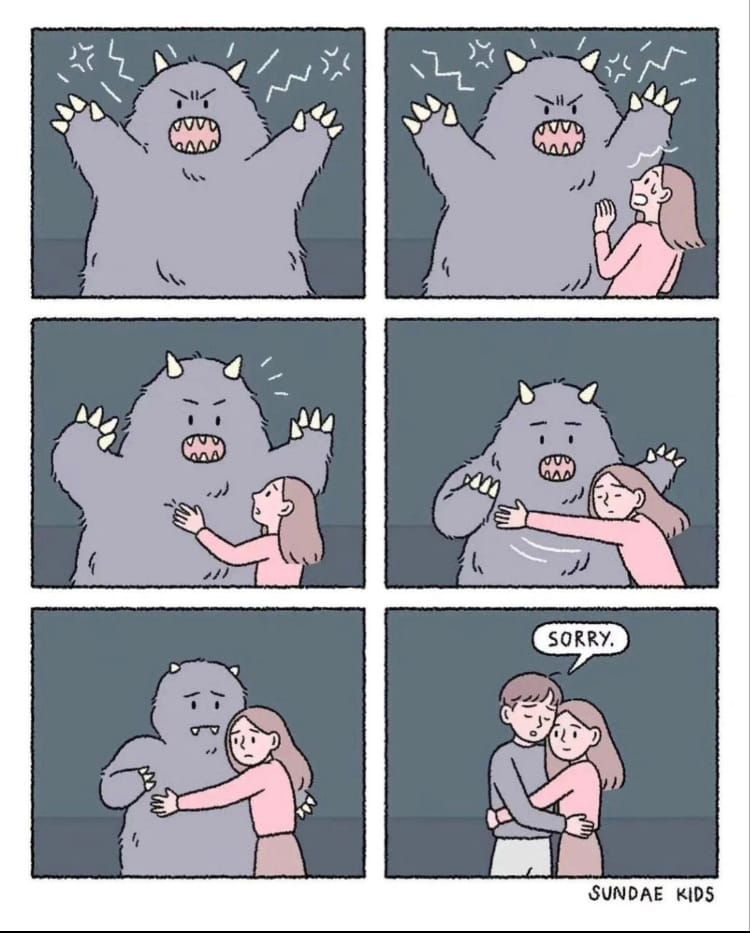
There is only one thing that can truly resolve anger and prevent it from solidifying into hatred: conversation. Not slogans, not suppressive techniques, not “letting go” while the wound stays open—actual dialogue with the person or group that caused the harm.
Angry people are, by their very nature, trying to communicate. Anger wants to be heard. A person with a grudge will talk for hours if someone is genuinely willing to listen. They will tell you exactly what happened, how it felt, and why they cannot accept it. This is not dysfunction; this is the psyche offering you, again and again, a chance to understand and repair the relationship.
Walking away is worse than any combination of words. Blocking is worse than any outburst. Shutting down communication flings the relationship further away from healing and deeper into dysfunction. Every time a potentially reparative conversation is avoided, the anger is forced to fester, and the hatred grows thicker.
If we truly want less hatred in the world, the solution is not to shame people for feeling it. The solution is to make dialogue non‑optional for those who cause harm. To normalize sitting down at the table, even when it is uncomfortable, and staying there until the message anger is trying to deliver has been fully heard and responded to. The path out of hatred runs straight through conversation, not around it.
And this doesn’t just apply to one‑to‑one relationships. Our hatreds often point beyond individuals, into larger patterns and roles—into archetypes that need their own kind of dialogue...
7. When hatred is archetypal, not personal
Not every instance of anger or hatred is directed at a single individual who personally committed a clear, discrete act against you. Sometimes what you feel toward a person is really aimed at an archetype they represent, or at the group they belong to, or at a role they are playing in a much older and larger drama. You may never have met them before, but they walk into the room wearing the uniform, the badge, the gender, the class, the profession, the ideology that has harmed you and your people for years.
In those moments, the psyche is not angry at “John” or “Sarah” as private, isolated souls. It is angry at the archetype: the exploiter, the betrayer, the colonizer, the abuser, the collaborator, the one who stands on the benefiting side of a long train of injustice. Your hatred is tracking something real at that level—the fact that they are currently embodying and benefiting from a pattern that has already done serious damage, even if they themselves have never laid a hand on you.
This is not an excuse to falsely accuse them of crimes they did not commit. Archetypal hatred still has to be honest. The task is to name the archetypical nature of your animosity—to say, in effect: “You personally may never have hurt me. But you stand in for a role, a class, an institution, a pattern that has. And my body can’t tell the difference.” That acknowledgement opens the door for a different kind of conversation, one that is less about individual blame and more about working together to heal an ancient collective wound by understanding it.
When you approach it this way, archetypal hatred becomes an opportunity to do collective healing work. It becomes a chance to bring the larger pattern into the room, instead of pretending the relationship is purely personal and history doesn’t exist. You can tell the person: “I’m angry at the archetype you represent. I want to talk with you, not to punish you, but to see whether you are willing to help heal what that archetype has done.”
Sometimes, nothing will come of it; the person will choose apathy, deny the archetypical dimension, and walk away. But sometimes they will listen. Sometimes they will accept that they are standing in a role that carries inherited responsibility, and they will sit down at the table as a representative of that role. And when that happens, your hatred is no longer just about you and them—it becomes part of a larger, necessary conversation about how entire groups and archetypes have been hurting each other, and how that hurt might finally begin to unwind.
In this way, even hatred that is not strictly “fair” at the individual level can still be honest at the archetypical level, and can still be turned toward dialogue, understanding, and repair. The key is transparency: to make it clear that your aim is not to dump guilt on a random individual, but to speak to a pattern, through a person, for the greater good of collective healing.
Which brings us back to you—to what your hatred actually says about who you are, and what kind of world you’re still trying to live in.
8. Hatred is not a sin.
Hatred is not a personal failure. It is the scar tissue of anger that tried to do its job and was blocked at every turn—by evasion, by apathy, by a culture that punishes those who feel too much and rewards those who feel nothing at all.
When you see hatred in yourself, what you are looking at is not proof that you’re a monster. You are looking at the record of how deeply you were hurt, and how many times your attempts to speak about that hurt were shut down. You are looking at the fact that you still care enough about justice, about truth, about what this world could be, that you could not make yourself go numb.
If you’ve made it this far, if you’ve stayed with these ideas instead of slamming the door on them, that alone says something important about you. It means you’re willing to question the story you were given about your own emotions. It means you’re willing to consider that your anger and hatred might be evidence of your humanity, not a defect in it.
You don’t need to be shamed for that. You deserve some credit for still feeling, for still noticing, for still wanting the world to be less cruel than it is. Hatred is a sign that your dedication to justice hasn’t yielded yet, that you haven’t gone fully over to the side of apathy. If anything, that’s the part of you the world needs most.