Crystals, Cacao, and Contradictions

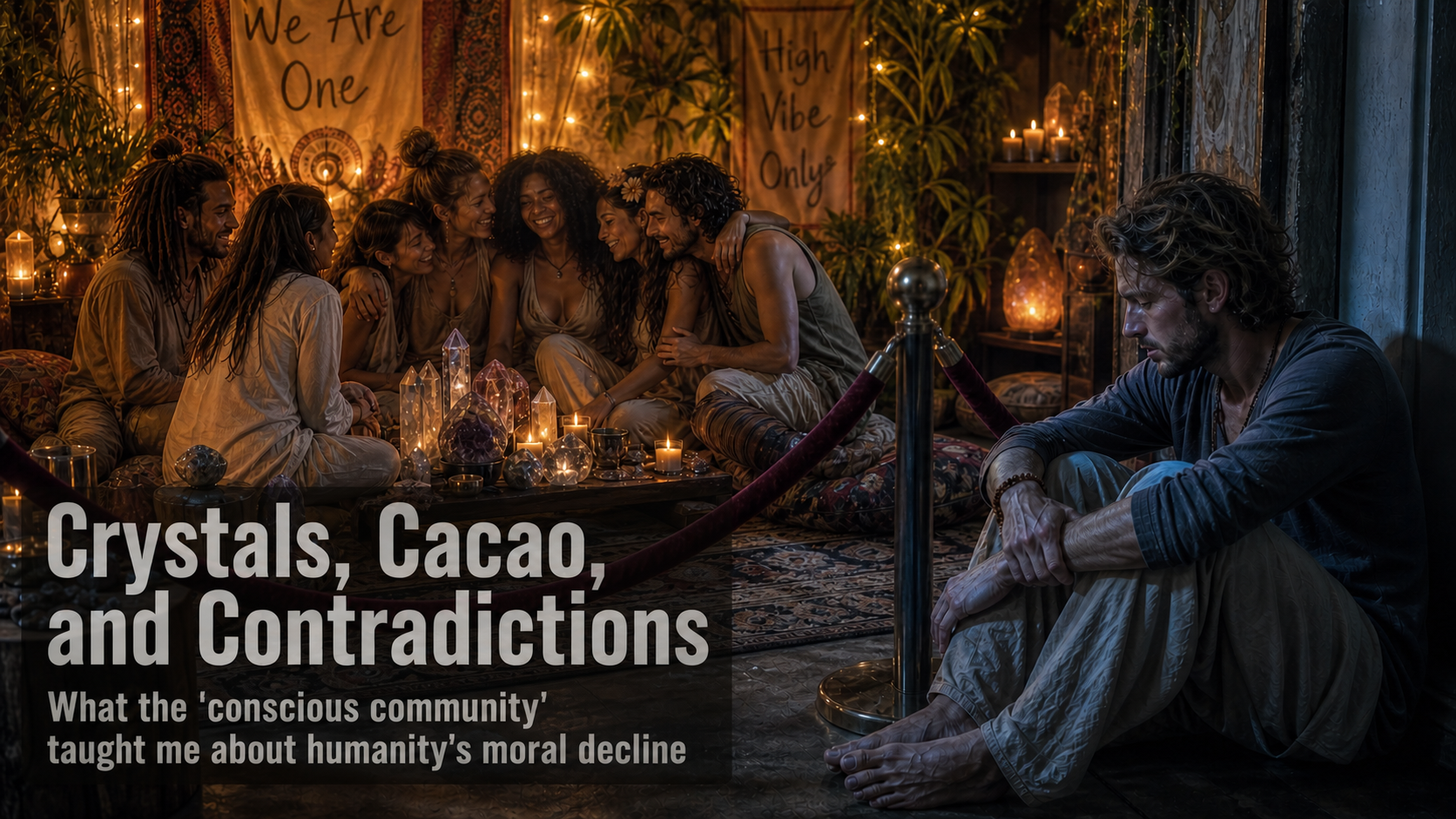
What the “conscious community” taught me about humanity’s moral decline.
I’ve been searching for something I haven't yet experienced: an authentic community of people who cared about truth, about conscience, about living in alignment instead of sleepwalking through life. For years, that search felt like wandering through a desert with only rumors of water.
I grew up in Baltimore, where there was basically no community—at least not in any authentic sense. It was a social desert, a place where people went to work, came home, numbed out, and maybe went to bars, but there was almost nothing that felt remotely like a tribe built around meaning, conscience, or truth.
In my early twenties, I started hearing rumors that elsewhere in the country there were these little pockets of people who were into the things I had always thought humans should be into. Nature, yoga, drum circles, dancing, solstice and equinox gatherings, full moon ceremonies, actual rituals under the sky instead of alcohol under fluorescent lighting. I heard about places where people wore crystals and hemp clothing, where the aesthetic signaled that they cared about the planet and their bodies and something bigger than themselves. For someone like me, trapped in Baltimore’s social desert, that sounded like the promised land.
So I started traveling. One of the first places I went to was Asheville, North Carolina, which had this reputation as a kind of hippie‑spiritual hub. I checked out Boulder, Sedona, various spots in California and Oregon and Washington, Austin, Santa Fe, Taos—wherever I thought I might find people who gave a damn about consciousness and community. I didn’t immediately settle anywhere; I just sampled these places, like I was circling around the idea of home without quite landing on it. Then I left the country altogether and lived in China and Southeast Asia for a while, trying to find something that felt sane somewhere on this planet.
I came back to the United States in 2020, right before the “pandemic.” That timing wasn’t intentional; I didn’t know what was coming. The next two years were basically a planetary freeze‑frame—everyone holed up in their homes, no real social life to speak of, whatever nascent communities existed going into hibernation. In 2021, I did WWOOFing—working on an organic farm near Asheville in exchange for room and board—and because the world was more or less on pause, I ended up staying at that one farm the entire year.
Finding the “Conscious Community”
Then, in 2022, I stumbled onto something that seemed like the answer I’d been looking for since Baltimore: a Telegram group called the Asheville Conscious Community. Just the name lit something up in me. “Conscious Community” was exactly what had been missing from my life. Here was a hub where people were organizing ecstatic dances, drum circles, cacao ceremonies, solstice and equinox gatherings, authentic relating circles—all the things I had been trying to cobble together by myself out in the woods. Ecstatic dance, for example, was something I’d discovered alone—hiking into the wilderness, finding a clearing, and letting my body move however it wanted to. I didn’t even know it had a name until someone told me, “Oh, that’s ecstatic dance; we do that here every week.”
So imagine what this looked like from my perspective: after decades in a social desert, after wandering through different cities and even continents, I had finally found a place that called itself conscious, that gathered around the activities I believed humans should be doing when they socialize. Not bars with dollar sliders and cocktails, not shouting over music in some neon box, but dancing barefoot on wooden floors, drumming under the moon, sharing hearts in circles. It felt, on paper, like I’d finally found home.
I threw myself into it. I became very active. I tried to do some event or activity every day. I went to ecstatic dance on average twice a week, to authentic relating circles every week, to all the full moon gatherings and solstice ceremonies and whatever else was on the calendar. I wasn’t just showing up physically; I was trying, consciously, to be the kind of person I would want in my own community.
I was kind. I was funny. I was engaging. I did favors for people. If someone needed a ride to an event, I’d give them a ride. If someone needed help with something, I’d offer. I cooked food—Indian, Thai, the kinds of foods this crowd tends to love—and I would just hand it out for free. People loved the food. People would ask me if I had anything, and I would say, “Sure,” and share more.
But I remained an outcast… Why?
And yet, something strange started happening—or rather, not happening. No matter how much I showed up, how much I contributed, how much I tried to be generous and warm and useful, none of it translated into actual friendship. I couldn’t get anyone to care about me outside of the official public events. I couldn’t “graduate” a single relationship beyond acquaintanceship. An acquaintance is someone you wave to when you see them at an event, maybe chat for a minute or two, and then you both go your separate ways.
What I wanted was a friend—someone who would say, “Hey, do you want to hang out?” on a random Tuesday; someone who would invite me to a small gathering; someone who wanted to run errands with me, go hiking with me, introduce me to their friends, hang out with me, work on projects together with me. You know, the normal things friends do in a normal world.
None of that happened.
Instead, event after event, night after night, I felt like I was inside a giant brain where every other neuron was firing connections except me. In the closing circles at ecstatic dance, everyone would be sitting together, sharing feelings, people going “ooh” and “ahh” at each other’s vulnerable shares, bodies curled into little cuddle piles, the room thick with “connection energy.” And there I was, the one neuron not connected to any other neuron. Tuesday night, Wednesday night, Friday night, Saturday night—it was the same pattern every single time. Them, connected with each other. Me, completely alone in the middle of it.
One by one, people leaned forward and poured their hearts out:
“I just feel so held by this community,” one woman would say, eyes glistening. “I’ve never felt so safe with other humans before.”
“I’m really celebrating my nervous system right now,” another would add.
“Like, my inner child feels so seen.”
Every time someone finished, there’d be a chorus of little murmurs and sighs and soft “mmm” sounds. People would stretch out their hands to touch each other’s shoulders or knees. Cuddle piles would form—two, three, four bodies leaning into each other, stroking hair, massaging backs, whispering “I love you” and “Thank you for sharing.”
I sat there too, watching this neural network of affection in real time. It was like being inside a brain made of humans. Every time someone spoke, little tendrils of contact lit up around them—hands on thighs, heads on shoulders, someone crawling across the circle to hug them.
Every time someone shared something profound, the crowd would go “ooh” and “ahh”—and each one of those little sounds felt like knives stabbing me, reminding me of what I don’t have, have never had, and might never ever have.
While everyone else was swimming in juicy love energy, I was fantasizing about methods of suicide. Right there in the sharing circle. And no one knew. Because I had no way to tell them. Because none of them would be my friend or have a conversation lasting more than 60 seconds. How do you tell someone you’re thinking about killing yourself if they’re not even talking to you in the first place?
A few times, I spoke up about this.
“I’ve been coming here a lot,” I’d say, “and I really appreciate the space. But I’m also noticing that, outside of this room, I’m still alone. I’d really love to find actual friends here, not just people I see at events.”
The room would go still in a different way. Not the reverent stillness they gave each other, but the way a herd of animals goes quiet when they hear something they don’t recognize. A few people would nod politely, eyes glazed. No one would reach out. No one would say, “Hey, let’s fix that. Come over on Thursday.”
Instead, the facilitator would say something like, “Thank you for sharing, brother,” in that soft, practiced voice, and then pass the stick to the next person.
“I just feel so overflowing with gratitude,” they’d say. “I’ve never felt so connected to everyone in this room.”
And everyone would “mmm” again, cuddle in, lay their heads in each other’s laps. The neuron network fired and pulsed and glowed, and I remained the one dark node on the edge of the brain, unconnected to anything else.
When the circle ended, people would swarm each other—hugging, making plans, “We should get coffee,” “Let’s hike next week”—and somehow, without ever being explicitly excluded, I would be circumvented. Bodies flowed around me the way a river separates around a rock. Smiles, nods, then they’d pivot mid‑step toward each other. By the time the last person filtered out, I’d be one of the only ones left standing in the empty room, wondering how it was possible to be this surrounded and this invisible at the same time.
I asked for help… and got shut down… hard.
After a while, I couldn’t just shrug this off as “bad luck” anymore. So I did what we’re all told we’re supposed to do in situations like this.
I started asking for help.
I didn’t storm in accusatory. I wasn’t aggressive. I approached people politely:
“Hi, I have a problem. Can I talk to you about it? Here’s what I’m noticing. What would you do in my situation?”
I framed it as a request for feedback, for guidance. I gave them every opportunity to be the conscious, caring community they claimed to be.
And what I noticed was that as soon as I did that—as soon as I tried to talk about the fact that I was being socially excluded—the already‑shallow acquaintanceships collapsed altogether. People pulled back even further than they already had been. Someone I’d been chatting with regularly at events would suddenly become distant, then vanish. Conversations ended. No one followed up. Asking for help about being excluded turned acquaintances into “nothingships.” They stopped talking to me at all.
This didn’t make any sense to me, given the branding. This was supposed to be a community. Communities are supposed to care about the people in them. I wasn’t demanding that the entire group of hundreds or thousands drop everything and focus on me; I just thought it was reasonable to expect that at least one or two people would reach back if someone said, “I’m alone here, and I’m struggling. Can anyone help?”
But no one did.
Eventually I escalated to the only avenue left: I started posting in the Telegram group itself. I wrote about my experience of being consistently left out, about how I could not seem to form a single genuine friendship despite all my efforts and contributions. I asked for help publicly, because the private route had failed.
A few people responded—but only with shallow advice:
“Read this book.”
“Listen to this Joe Dispenza interview.”
“Do this breathing exercise.”
“Go out and talk to people.”
“Touch grass.”
“Become open to receiving.”
But I had already read the book. Twice. And that book, and that other book.
I already knew how to breathe; I’m a registered yoga teacher.
I already talk to people; I’m highly social.
I live outside. I don’t just touch grass—I sink my feet in the mud. I sleep under the stars.
And what the hell does “become open to receiving” even mean? What are the actionable steps for that?
All the advice was either something I’d already done, something beyond my ability at all, or something too vague to act upon. And when I told them this, they would get angry and accuse me of being closed‑minded and “not ready to evolve.” Then they’d stop responding. And often, they’d block me.
Imagine that. Imagine someone comes to you asking for help, and you block them.
What kind of person does that?
Meanwhile, other observers began telling me that the group was “not an appropriate place” to talk about my problem. They said I shouldn’t be posting about my exclusion or loneliness there. They started threatening to ban me if I kept it up. So now, not only was I being ignored in my attempts to seek help, but I was being punished for even asking.
What kind of person must you be to do that?
It’s like walking past a homeless person begging for food, and not only refusing to help them eat, but stepping in to prevent others from feeding him. Not only will you not give—you actively spend energy and time making sure others can’t give, even if they want to.
“No, no, no. Don’t feed him. This is not the correct container for him to receive food. He should not be getting food here.”
That second step—actively preventing others from helping—is what they did to me.
Stifled by containerism
I call it “containerism.” You can only talk about certain things in certain places. There’s a “right container” for everything, and God forbid you be visibly suffering in the wrong chat or the wrong circle.
And here’s the key: nobody claiming “this is the wrong container” ever told me what the right container was. Except for “go to therapy.”
But I can read between the lines. They found my struggle too messy and didn’t want to hear it, so they attempted to shunt me off to some “professional” somewhere so they could be rid of me. By suggesting “therapy,” not only were they making assumptions that I could:
- Afford it—which I couldn’t, and
- Hadn’t already tried it a dozen times—which I had,
but they were also, in the larger sense, attempting to sanitize my suffering by sending it off to someone else, somewhere else.
From my side, I was doing exactly what the mental‑health culture tells men to do: reach out, ask for help, say that you’re lonely and struggling. They read articles about the male loneliness epidemic, about how men become radicalized when they’re isolated and unsupported. They nod along, wring their hands, talk about how men need to open up more.
And then, when an actual man in their actual community does exactly that, they not only ignore him, they try to silence and remove him.
The one who would help is the only one who gets no help
The most ironic part is that, if the tables were turned, I would have helped.
Imagine that I had a diverse, full, satisfying social life. Imagine I had friends, people who cared about me, an intimate partner, regular touch, affection, sensuality, sexuality—some real place in the social and emotional life of other humans.
Then imagine someone in my orbit had none of that. No friends. No love. No touch. No intimacy. Not merely a bad week or a temporary rough patch, but a life in which those things had never really arrived.
And imagine that person was speaking about it openly. In public. In front of groups. Asking—sometimes begging—for help.
I would not hear that and think, “This is negative. It’s bringing down the vibration.”
I would be horrified.
I would think: Has this person really lived this long without what most people take for granted? Has he really been trying this hard, speaking this openly, and still found no one willing to reach back?
And I would feel compassion.
Maybe that makes me strange. Maybe it is strange to feel a tidal wave of pity when someone is suffering in a way I can barely imagine. But when I see a person who is genuinely trying, who cannot solve something alone, who needs a little help and has the courage to say so, my response is not to get rid of them. My response is to want to help.
Yet despite the fact that I would help someone in that situation if I had the power to, I was the person nobody wanted to help.
People would say, “I can't help you. There’s nothing I can do.”
Oh but there is.
It would have been simple: friendship.
That’s what would have helped.
It is like being on a swing set. I am trying to get the swing moving, but I need a small push to start. Once there is momentum, I can pump my legs. I can carry myself. But without an initial push, I remain stuck at the bottom, working against gravity with nothing to build from.
Friendship works like capitalism
Social capital works much like financial capital. You need some to make more. You need to have it in order to accumulate it. If you begin with none—no friends, no invitations, no people who will vouch for you, no web of relationships—you are trying to acquire social capital from the outside with no entry point.
The way to help a person like me would have been to give me a little starting capital: basic friendship.
Someone could have let me be a small part of their life. If they were going somewhere social, they could have invited me along. They could have introduced me to friends. They could have shown, through ordinary association, that I was a normal, safe person who had people in his life.
That kind of social proof matters.
If people see you in a group—if they see that somebody knows you, likes you, trusts you, wants you around—it changes how you are received. It gives you a foothold. It makes it easier to relax, easier to connect, easier to show the parts of yourself that are warm, creative, funny, generous, and alive.
With a little social capital, perhaps I could build more. I could become happier, more confident, more naturally likable in social settings—not because I had become a different person, but because I had finally been given enough room to be myself.
It really is that simple.
Someone could just be my friend. Give me a little push on the swing set. Help me make other friends. Help me get started. An initial spark to kindle a fire.
Everyone is capable of being a friend. It is not some advanced spiritual skill.
You check in on someone with some regularity. You ask how they are doing. You ask whether there is anything practical you can help with. You invite them along when you are going shopping, hiking, doing errands, working on a project, meeting friends, cooking dinner, or doing something ordinary.
And, if the person is a good friend in return, they offer things back. Friendship becomes reciprocal. It becomes a two-way relationship. That is how human beings have always helped one another survive.
People seemed to think I was saying, “You need to date me.”
No.
Nobody owes me romance, sex, or an intimate partnership. That was not the request.
But someone could have helped me date someone else. Someone could have helped me build the basic social footing from which connection becomes possible. That is not complicated. It is not burdensome in the way people pretended it was. It is not an impossible demand.
It is friendship.
And yes, I have talents. I have creativity. I have things to contribute to the world, to a community, and to friends. I can cook. I can help. I can make people laugh. I can generate ideas. I can show up. I can contribute to projects and make things better.
But it is difficult to access all of that when you are socially starved. You need some degree of belonging, companionship, intimacy, and human warmth to fully access and develop your creativity. You need a life that contains something other than permanent exclusion.
Give me that little push, and I could have built from it. I could have become more fully myself. I could have contributed in beautiful, useful, generous ways.
But despite the simplicity of the ask, I could not find a single person in the "Conscious Community" who would do it. Who would simply be my friend.
That is why I began to see hypocrisy everywhere. Eventually I started assuming it by default.
The pattern was deeper than casual apathy
That was when I started to realize that what I was dealing with wasn’t just a bunch of individuals with random flaws. It was a pattern. The hypocrisy of telling men to ask for help and punishing us when we do was only the tip of the iceberg.
People would do other things that were dishonorable on levels beyond this.
For instance, they’d make commitments to me, like “We’ll talk about this on Friday, give me a call”—and then mysteriously back out. They’d invite me to events and then rescind the invitation, with no explanation. They’d do all sorts of small but callous acts of betrayal and dishonor.
And I understand that people make mistakes, forget things, over‑schedule themselves. I get that. But what made it significant was the total absence of apology, or any acknowledgment of error. When I finally, politely reminded them of what they’d said and what they hadn’t done, they blocked me. No apology, no explanation, not even a single sentence in response.
And if I told a third person about it, the third person would attack me for pointing out the lack of integrity, while defending the person who lacked it. They’d condemn the victim while supporting the perpetrator.
And the excuse would always be:
“This is negative. It’s bringing me down. I want to feel good. Bye.”
Feelings matter more than honor and integrity
I began to see the same thing everywhere I looked in this so‑called conscious community: a pattern of moral inversion. People had replaced morality and honor with feelings. All behavior was being judged according to how good or bad it made the recipient feel, with the question of right and wrong left completely out of the equation.
There was no independent standard of morality anymore. Right was simply whatever felt good; wrong was simply whatever felt bad.
If I pointed out that someone had broken their word to me—said they would do something and then vanished without doing it—it didn’t matter whether I was correct about the facts. What mattered, in their value system, was that my pointing it out made them feel uncomfortable.
My words made them feel “bad,” therefore my words were “wrong,” therefore I was wrong.
End of story. No discussion of obligations, promises, or honor.
And they’d rub it in by saying:
“No one owes you anything.”
Um, yes, actually, you do.
Everyone owes everyone integrity. As members of a society, people have obligations to other people. If you give someone your word that you’re going to do something, you owe them that thing. Even if there’s no legal contract, even if the state isn’t going to fine you for breaking your promise, there is still such a thing as moral accountability. Your friends, your community, your “tribe” should be able to admonish you when you break your commitments and push you toward being more honorable.
The same with accusations. If you publicly accuse someone of wrongdoing, you owe them your presence until the matter is resolved. You either defend your accusation with evidence, in front of the community, or you retract it and apologize.
What you don’t get to do, in any honorable system, is lob an accusation, plant seeds of doubt about someone’s character, and then run away like a coward when they ask you to back it up.
And yet that’s what kept happening to me. People would accuse me of “attacking everyone who tries to help me,” for example, and when I asked calmly, “Give me one example of a person who tried to help me and whom I attacked,” they had nothing. They just repeated the accusation, refused to provide evidence, and when I continued to insist that they either substantiate or retract, they vanished.
In my view, that’s dehumanizing. The bare minimum someone owes another human being, when called out for breaking their word, is a sentence or two of acknowledgment.
“You’re right, I forgot; I’m sorry.”
That would have been enough for me.
But apparently, in this value system, their feelings of discomfort at being reminded of their own dishonor outrank that basic duty.
Sacred language without sacred obligations
Alongside all this, I started noticing the way they used language was duplicitous. They called things “temples” that were functionally clubs. They called their gatherings “churches” that never once admonished members for immoral or dishonorable behavior. They called a Telegram bulletin board a “community,” while summarily banning and disappearing people with no process, no council, no trial, no chance to defend themselves.
Words like “temple,” “church,” and “community” should carry responsibilities.
A temple should not be exclusive. A community should not un‑person members without some kind of fair process. If you want to run a social club that only allows happy vibes and silences neediness, then don’t call it a “community.” If you want to run a sex club and only invite people you find attractive, fine—call it a club, not a temple.
Don’t appropriate sacred language to sanitize exclusion.
When I called this out, I got the same reaction as when I asked for help: not curiosity, not self‑reflection, not gratitude for someone doing the hard work of honest critique, but hostility. People attacked me for “bringing bad vibes” or “making people uncomfortable” when I pointed out concrete examples of broken promises, double standards, and hypocrisy.
The leader of a so‑called “Chocolate Church” didn’t admonish the people who treated me dishonorably; instead, the congregation piled on me for naming what had happened. In a real church, you’d expect some kind of moral framework, some expectation that members hold each other accountable to shared principles.
What I saw instead was a kind of spiritual‑aesthetic club where the only real commandment was:
“Thou shalt not make anyone feel bad.”
At a certain point, the conclusion became inescapable
The conscious community, as I experienced it, was not more conscious than the general population. The only difference was the aesthetic: crystals instead of crosses, cacao instead of communion wine, ecstatic dance instead of club dancing, but the underlying moral cowardice was the same.
They valued feelings over truth. Tone over message. Consensus over justice. Vibes over integrity.
Their sacred words—community, temple, church—were marketing copy, not commitments.
And this wasn’t just some unfortunate, isolated experience I happened to have in one town. The more I thought about it, the more I saw that the pattern I’d encountered in Asheville was the same pattern playing out at the level of the whole civilization: a culture that has abandoned any independent standard of truth or morality and replaced it with “whatever feels good to me in this moment.”
A culture where blocking and banning and silencing are treated as virtues—self‑care, boundaries—rather than what they actually are in the context of truth: premeditated ignorance.
My personal story with the conscious community is just one microcosm of that larger pattern. I went looking for the best that humanity had to offer, the “cream of the crop,” the people who claimed to care about being awake and ethical and connected.
What I found was that even there, maybe especially there, the reigning value system was anti‑truth and anti‑honor.
And once you see that in the so‑called conscious community, it becomes a lot easier to understand why the rest of humanity is losing.