The Epistemic Intimidation Cycle

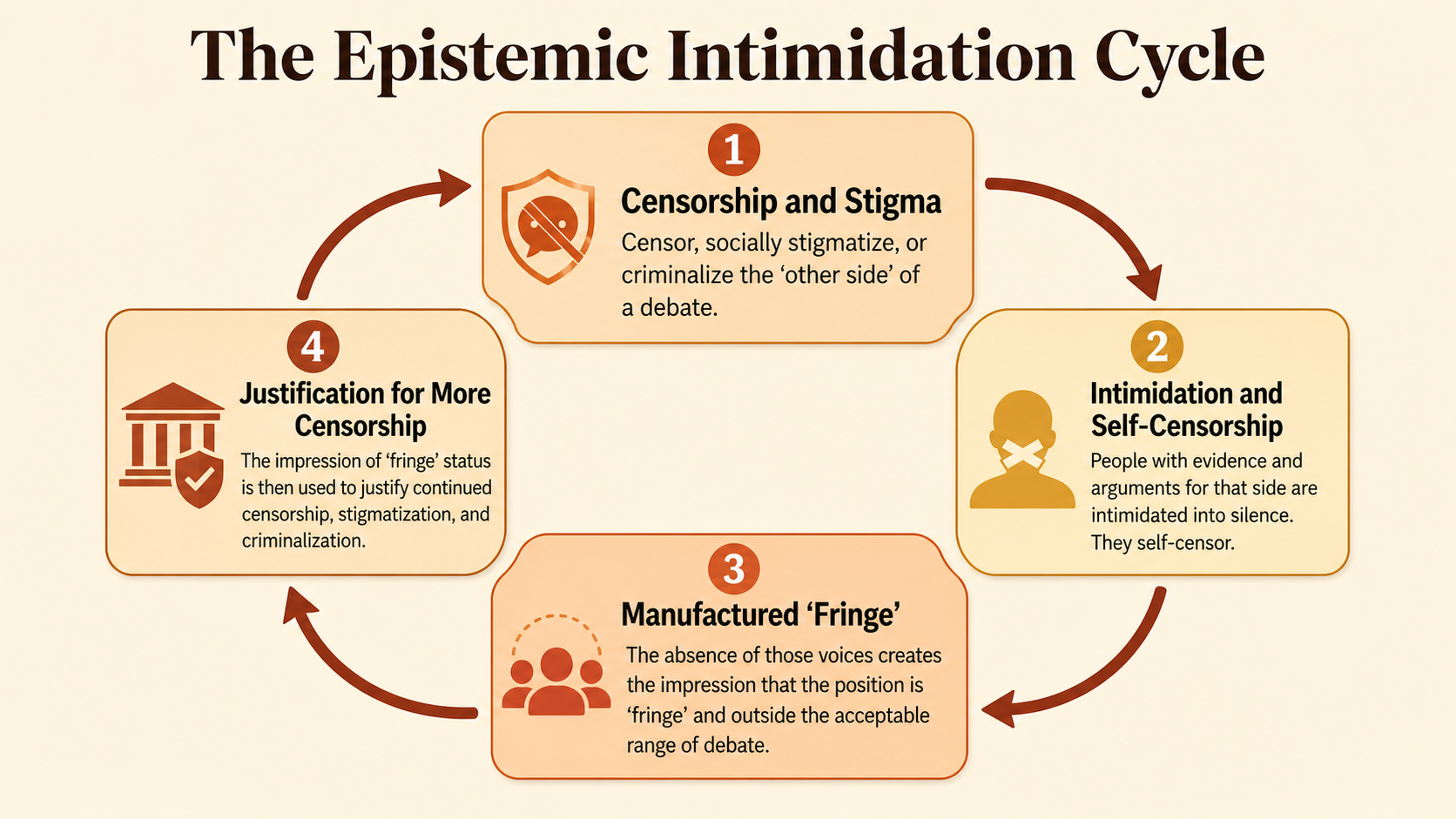
Every single controversial topic in the world is affected by this cycle.
Immigration. Vaccines. Israel. Abortion. Climate. “Who killed Charlie Kirk.” If people argue about it, the Epistemic Intimidation Cycle is wrapped around it and squeezing.
- It censors and stigmatizes the “other side,” or even criminalizes it.
- That intimidation causes people on that side, including genuine experts, to self‑censor, disappear, and keep quiet.
- Their absence then manufactures the illusion that their position is “fringe” or non‑existent, which justifies more censorship and stigma.
- The missing voices are then used as “evidence” that those positions are fringe. “If there were anything to that view, we’d be hearing from real experts.” Meanwhile, behind the scenes, the very people who are trying to speak are being systematically shoved off the stage.
And round and round it goes.
And it’s not just “out there.” It’s affecting you, inside your own mind. Because your understanding of each topic has already been twisted by that cycle, because your first encounter with it took place inside a landscape that was already warped. You met the issue after the censorship, after the stigma, after the intimidation had already silenced entire categories of voices. You walked into the story halfway through, after one side had been shoved offstage.
Most of us are still participating in the cycle—even if we’re not actively censoring or intimidating anyone—because we still believe in the narratives that the cycle cemented. If you still believe what the “mainstream” believes on any given topic, and you’ve never truly studied the other side, then you haven’t broken out of the cycle yet.
The Conspiracy Knowledge Gap
Most people assume they’re qualified to judge conspiracy theories while only knowing one side of the story. They know the mainstream narrative; they know the late‑night jokes; they know what the debunking articles say. So they think they “know enough” to dismiss the conspiracy position.
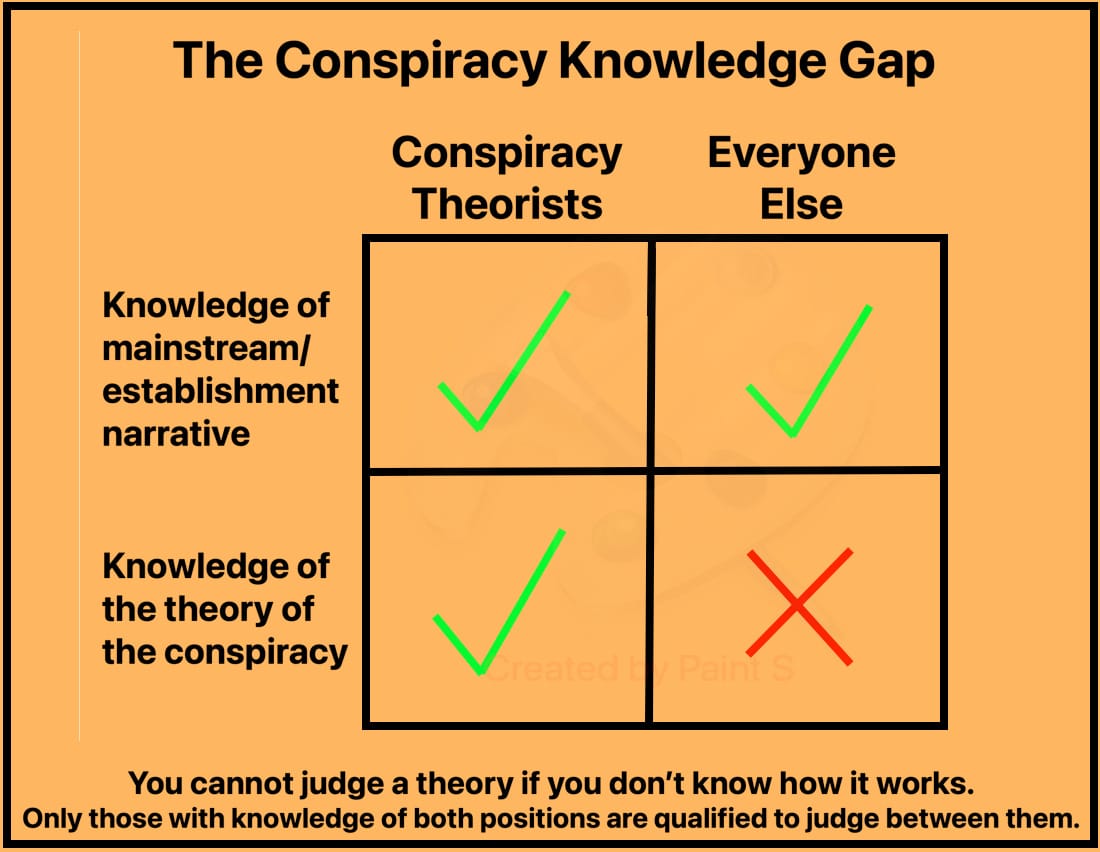
But look at the grid:
- Conspiracy theorists know both the mainstream/establishment narrative and the theory of the conspiracy.
- “Everyone else” only knows the mainstream narrative. They don’t actually know the conspiracy theory in detail, let alone its evidence.
You cannot judge a theory if you don’t know how it works.
Only those with knowledge of both positions are qualified to judge between them. Everyone else is just taking sides based on vibes and social pressure.
The Epistemic Intimidation Cycle guarantees that most people never get that second column. The “other side” is stigmatized, deplatformed, throttled in search results, mocked in culture. So the average person never meets the actual arguments; they meet a caricature. They think they’ve rejected the conspiracy theory, but what they’ve actually rejected is a cartoon version of it, pre‑filtered by the very system they’re trying to evaluate.
How to break out
You don’t escape this by “being neutral” or “trusting the experts.” Neutrality inside a rigged information environment is just obedience.
You break out by learning on purpose.
You deliberately seek out the “other side” of the debate—especially the side that’s being censored, stigmatized, or mocked. You don’t wait for it to be handed to you by the same institutions that are suppressing it; you go looking for it because you know that is where the intimidation is strongest.
- Ask yourself: on this topic, who is afraid to speak?
- Who gets fired, banned, de‑platformed, or ostracized for their view?
- Whose arguments are you being told “not to read,” whose videos are “misinformation,” whose books are “dangerous” or “harmful”?
Those are the people the Epistemic Intimidation Cycle is trying to erase.
Go find them. Listen to them. Read their best arguments, not just their worst examples. Learn enough about their position that you could explain it back to them in a way they’d recognize. Only then are you even eligible to make a judgment.
You may still end up disagreeing. You might study the “other side” and decide it’s wrong. That’s fine. But at least then your disagreement will be informed, not manufactured by censorship and a rigged knowledge gap.
Until you’ve done that, your beliefs on any controversial topic are not really yours. They’re the output of the cycle.