Your "Moral" System Is Probably Garbage

Most people do not have a moral system at all. They simply worship power.
When you ask them "where does morality come from?", their answer is almost always "power."
It usually doesn't sound like that. I rarely hear someone say "Might makes right." They have a system that appears to be more developed than that. But it's only a disguise. Their system claims morality on the surface, but if we strip away the layers, down to the core, it predictably all circles back to power. Whoever has the might, defines what's right.
This chart explains:
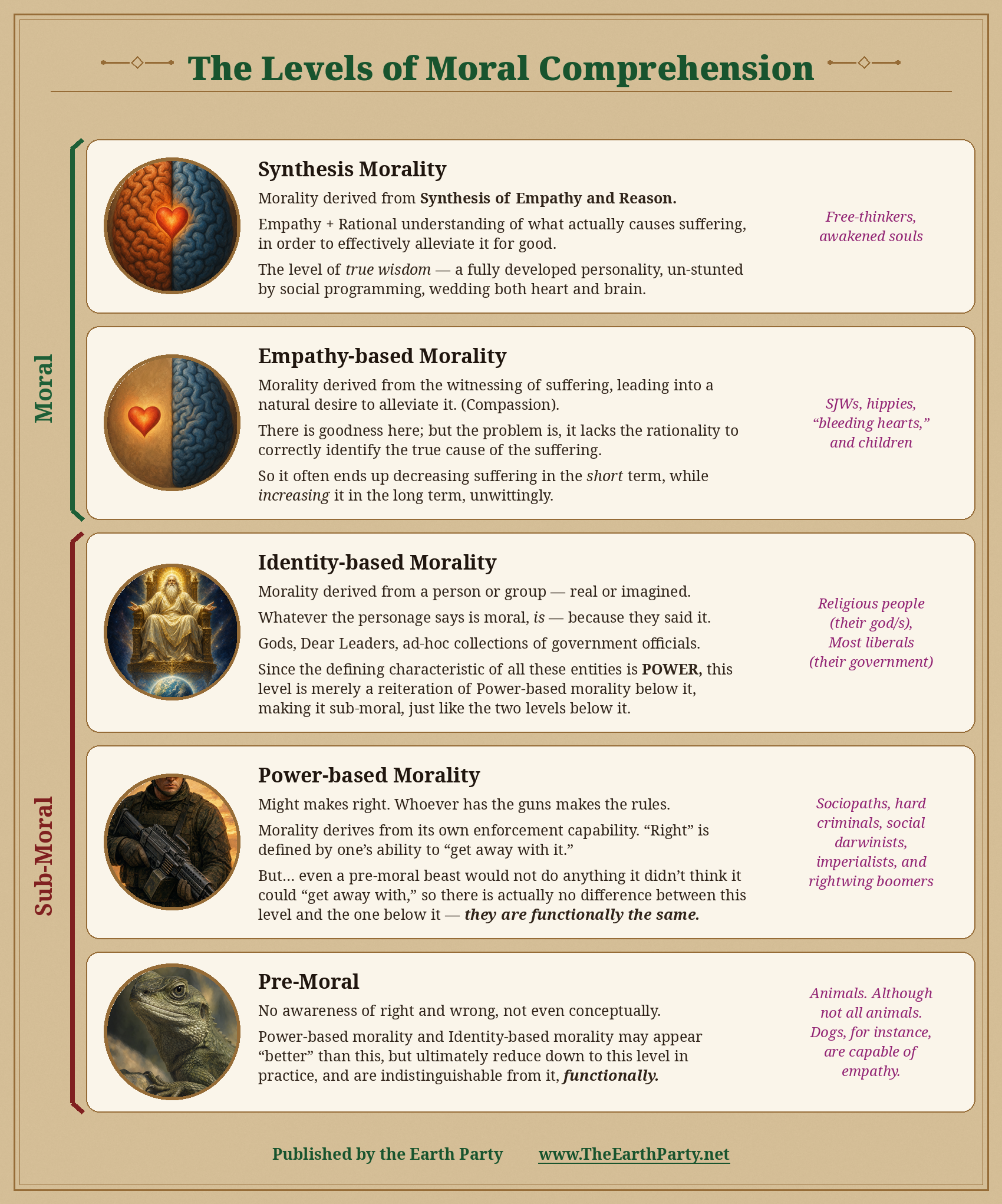
Most people are at the middle level of this chart. They believe that right and wrong comes from a who, not a what. And the "who" vacillates between two characters: a god and a government. Religious people believe it's a god, and the irreligious believe it's a government. And it's always theirs — their god, their government — conveniently.
But it's the same principle: Morality is based on identity. As in, "this person or group gets to define what's right and wrong."
And since power is what gives that identity its "authority," what they're really saying, underneath all the pretenses, is that power defines right and wrong.
Their "god" has authority because of his power.
Their government has authority because more people voted for the representatives in that room than voted against them — which is something called power in numbers.
So... power.
It's all fucking power.
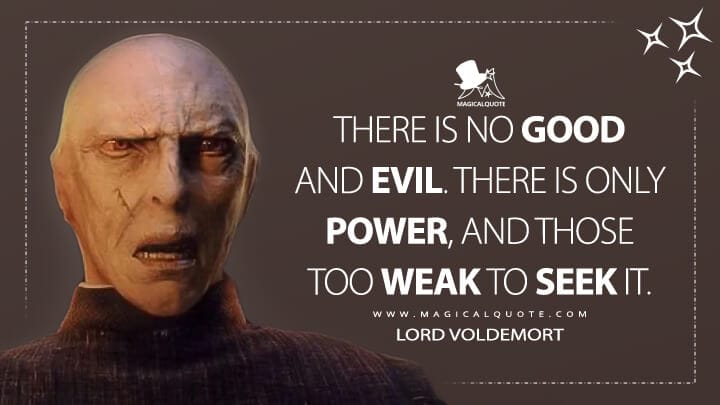
You Don't Get Moral Credit for Submitting to Power
Power-worship is not "morality" at all. It's the law of the jungle, wearing lipstick. A lizard or a jaguar will refrain from hurting you if it thinks you are stronger than it. That's not morality. That's self-preservation. And if you, as a human, also refrain from hurting those with power, or those protected by power, then your choice is completely unrelated to morality. Just like an animal.
You don't get moral credit for submitting to power. "Might Makes Right" is no different from having no morality at all.
And morality based on identity is no different from Might Makes Right, because the identity making the morality is always always always the identity with the most power. Like a government that owns a monopoly on force. Or the most perceived power, in the case of "gods" who aren't really gods and thus rely on human believers to do all their enforcement for them. Either way, the identity that defines morality only gets to do so because of power — and no other reason.
The Fix: An Objective Standard
Here's how you fix this: Objective Morality.
Morality doesn't change when the powerful decide to change it, because it does not, and cannot, change at all.
Morality is an objective truth, like the laws of mathematics or geometry. People don't "decide" how math works. We discover it. It exists independently of us, and we simply recognize it, as it is.
Morality has to be something unchangeable by man, or else whoever has the power to change morality will change morality to do whatever they have the power to do. And that's a totally unstable system. The people
under the standard can't be the ones deciding what the standard is — or else there is no standard. The idea collapses, and it defeats the purpose of having a word like "morality" in the first place. It's merely raw power.
The Other Half of the Equation: Empathy Without Logic
There is, of course, an off-chance that you're one of the minority of people who have figured out how stupid this is, or never fell for it to begin with. And instead of worshiping power, you base your morals on compassion and empathy.
And if you are such a person, then I do appreciate you. You're more than a beast. You are human. You are trying.
But you must understand... Empathy without Logic... is often ineffective, and sometimes counterproductive. So many people out there have the heart to care about the weak and the vulnerable — but the things they do in order to help them are not informed by a logical reading of the situation. They're not thinking rationally. They let their emotions take over, and run with the first "solution" presented. And very often that solution is useless. Sometimes it even perpetuates more of the problem. And sometimes, it's implanted nefariously by bad actors, to take advantage of your empathy, to advance their own agendas.
For example, giving money to the homeless is incentivizing the beggar lifestyle. You're paying people to be beggars — and whatever you pay people to do, they will continue to do. Because they're getting paid for it. If you really want to help them, be their friend, get involved in their life, and help lead them to integration and productivity. Or, if they're literally starving, feed them. Food and shelter, yes. Money, no.
I get that you want to help them. So do I. But do you want to actually help them, or do you just want to feel the feeling of being a compassionate good person?
Another example: Caring about climate change... and "doing something" about it by investing the very corporatocracy that created the problem in the first place with the new terrifying power to enslave everyone in a global carbon-credit system.
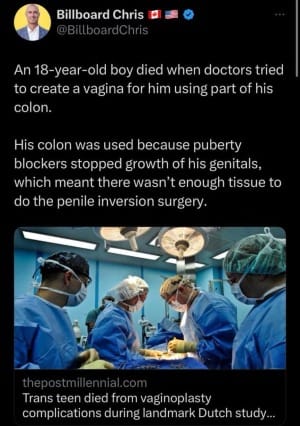
Another example: Caring about people with gender dysphoria, a very painful condition... but trying to "help" them by performing horrific medical experiments on them, to "change their sex."
Another example: Mass immigration. You feel sorry for the poor refugees fleeing wars and whatnot. But mass-transferring people from one land to another is bad for both the migrants and the host country. Mass population transfer was pioneered by the iron-age Assyrian Empire, and they did it to hurt people — by confusing and muddling the cultures, to disempower them and prevent them from challenging the empire.
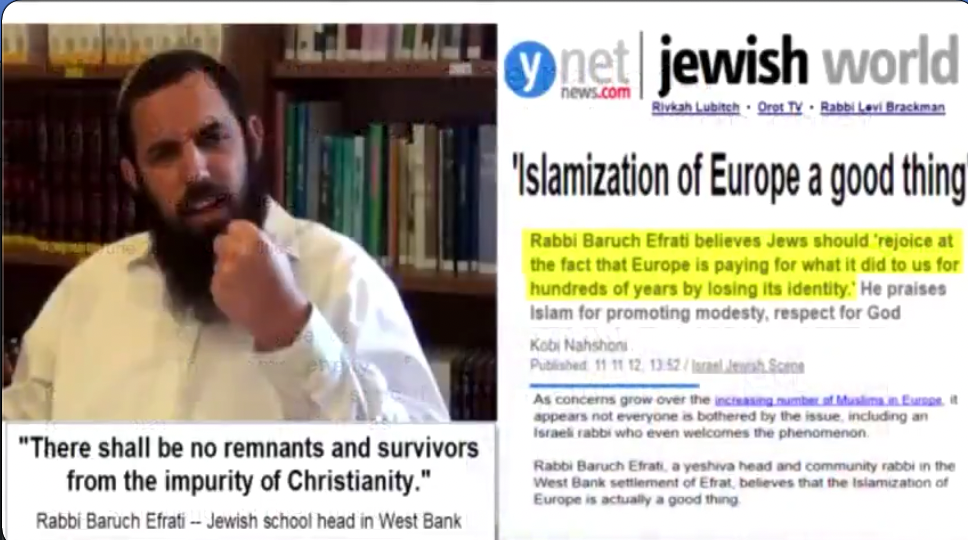
Peoples thrive best in the land in which they evolved. There is nothing compassionate about moving a pale Irishman to sunbaked Australia, nor a heavily melanated Somali to cold dreary Minnesota where he'll become depressed and Vitamin D-deficient. If you care about the Somali, help him heal Somalia.
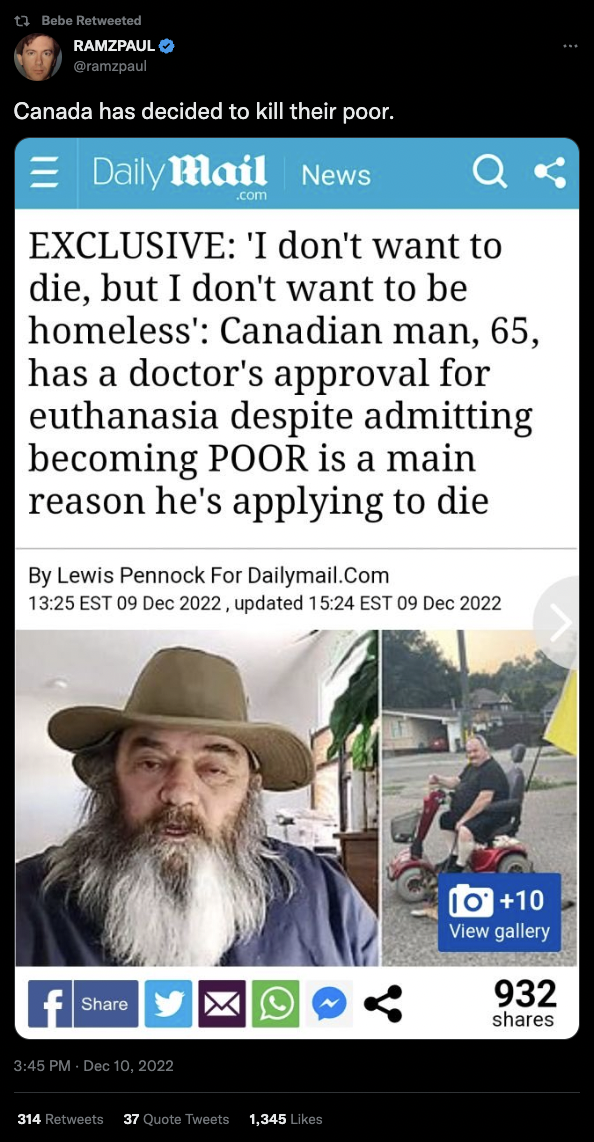
Another example: MAID (medical assistance in dying).
And they're doing it to children too.
Children!
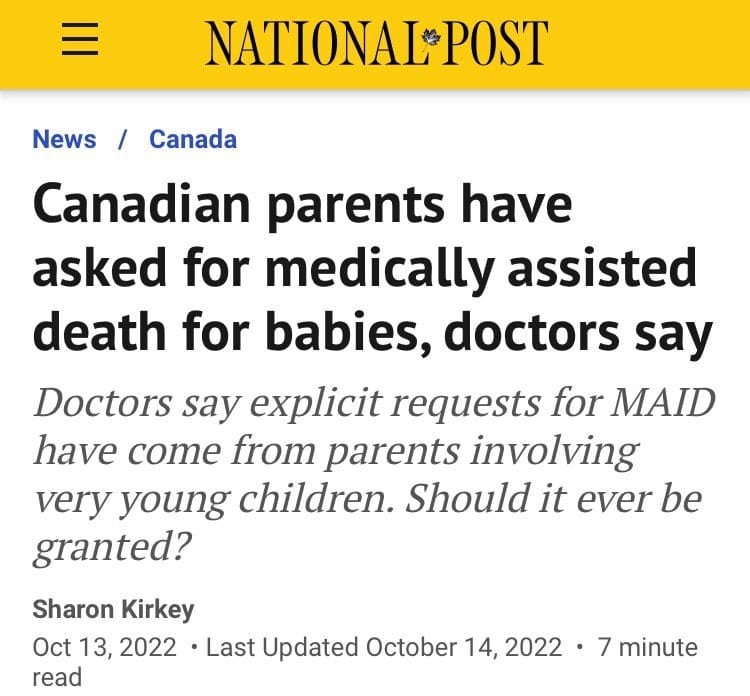
Is this compassion?
It's being marketed that way. And lots of people believe it - including the majority of some state/provincial medical boards.
Is it?
Combining Compassion with Reason
I love seeing people who care. I'd rather see a person who cares about something — even the wrong thing, or the right thing in the wrong way — than a person who doesn't care at all. Apathy is the worst of all vices.
And that's why it's such a shame to see so much passion wasted, diverted, or weaponized by the very forces causing the suffering in the first place.
You just watched two different failure modes wearing two different masks — one dressed up as authority, one dressed up as compassion. Both fail for the same reason: neither one is anchored to anything outside itself. Power-worship has no fixed standard. Empathy alone has no logic to steer it.
Empathy is a start, but it's not enough. You need to marry it to logic.