Dot‑Connecting Is the Epistemology Behind Conspiracy Theories

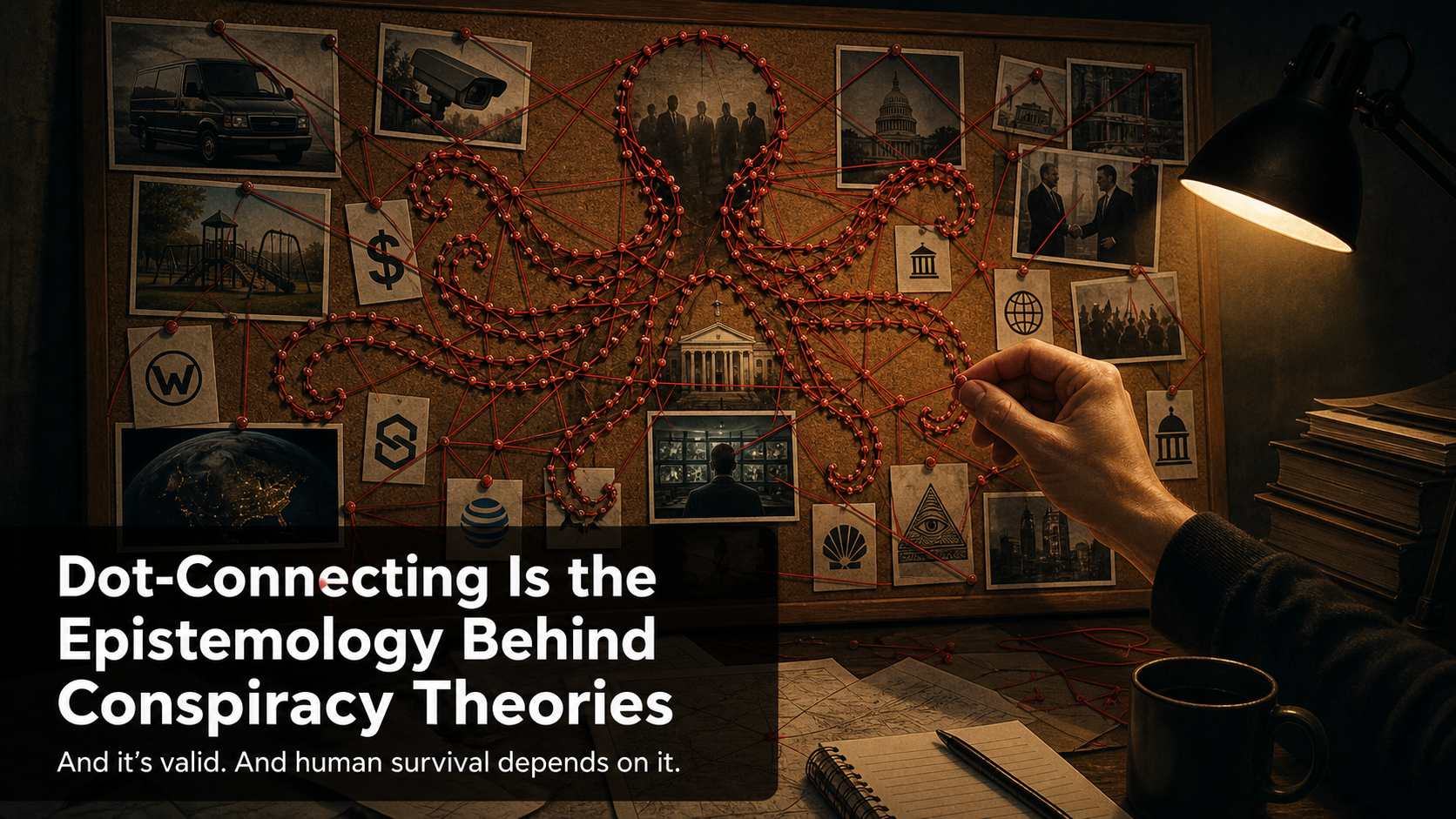
Dot‑connecting is the process of seeking truth by adding up data points which do not individually prove anything, but taken together paint an obvious picture.
Look at this picture. It’s part of an octopus. Can you tell?

No, of course you can’t tell.
How about now?

Not yet.

Is it starting to come together?

How about now?
Obviously yes. But here’s the key wisdom: None of the dots individually proves there’s an octopus. And if you demand that I prove each dot is part of an octopus, I can’t prove that—and you will not recognize the octopus. Ever.
To see the octopus, you must let go of the need for individual proof of each data point.
Conspiracy Theories Depend On Dot‑Connecting
This whole discussion is of paramount importance to our world and the fate of humanity, because it forms the foundation of “conspiracy theorizing.” And if you’re the type of person who reflexively dismisses conspiracy theories—and I don’t mean this theory or that theory, but all of them, as a category—then it’s because you don’t yet recognize the validity of dot‑connecting.

And in that case, you are recklessly endangering our world.
If you dismiss the entire category of conspiratorial thinking, you’re not just rejecting specific claims. You’re rejecting the epistemic strategy that conspiracy research is based upon. And that strategy is called dot‑connecting.
Perhaps a hard‑hitting example is needed.
The Parable of the Pedo‑Babysitter
You’re hiring a babysitter for your kids. Someone applies. On paper, he meets all of your criteria. His references are good. He interviews well. The kids get along with him. He’s affordable. He’s perfect in every way.
But then, you discover that:
- he drives a windowless van
- he spends weekend afternoons parked on the street next to a park with a children’s playground… just sitting there
- he always keeps a pair of binoculars on the dashboard
- he always keeps a bag of candy on the passenger seat
- he has a copy of Nabokov’s Lolita on the floor
- the van has a music machine and speakers that can blare ice cream truck tunes
There’s a clear picture here: He’s a creep. A perv. A pedo. It’s obvious.

Now imagine your spouse taking offense at the idea that he’s a pedo. They demand proof of your suspicion, backed up by authoritative sources—like a criminal record. They say:
“He has no convictions. Not even arrests or charges! There’s no evidence that he’s a pedo. What are you basing your suspicions on? Nothing! You’re just a bigot!”
And they’re right, in a narrow sense. You don’t have proof. You really can’t say you “know” he’s a pedo. Because none of the individual dots proves it alone.
Every dot has a “normal” explanation:
- The van? He’s an electrician, and he stores his equipment in it.
- Why windowless? So thieves can’t look in and spot his expensive stuff.
- The park? His favorite café is right there too.
- The binoculars? He’s an avid birdwatcher.
- The candy? He has a sweet tooth. Who doesn’t?
- Lolita? It’s literature. Are you a Neanderthal who has a problem with literature?
- Ice cream truck music? It came with the van when he bought it. Big deal.
None of this would hold up in court, as proof. No grand jury would even issue an indictment. It’s called “circumstantial evidence”, and it carries no incriminating weight. A judge would toss the case out.

But here’s the problem:
He’s a fuckin pedo.
But what can you say to your doubter? Really think about it. Put yourself in this situation, and brainstorm your response. How do you prove it? How do you convince your spouse not to hire a dangerous person who could abuse your kids and screw them up for life?
Now you’re thinking like a conspiracy theorist. This is the kind of dilemma every conspiracy theorist faces, every single day. How do you make people recognize something totally obvious, but without "confirmed" proof?
Life Is Not Clean, and We Have To Make Choices Anyway
Now switch roles. Put yourself in the shoes of the doubting spouse. Do you know, for 100% certain, that the babysitter is a pedo?
No. Not 100%.
Maybe 99%. Or 97%. Or even just 90%.
Maybe even as low as 70%.
But here’s the thing: You still have to make a choice. There are two options, and only two:
- Hire him
- Don’t hire him
There is no third option. You have to choose. And you must do so with incomplete knowledge. You will never have a perfect knowledge of anything. And this thing called “Life” forces you to make choices without perfect knowledge.
You use the dot‑connecting strategy yourself. You are always connecting dots in the people and scenery you see around you, to make assessments about possible opportunities and threats. You already acknowledge that dot‑connecting is a valid epistemic strategy, because you use it in your daily life, many times per day:
- You don’t have perfect knowledge that the can of soda doesn’t have strychnine in it. Yet you drink it.
- You don’t have perfect knowledge that the sidewalk won’t collapse into a sinkhole when you step on it. Yet you step on it.
- You don’t have perfect knowledge that the mafia didn’t cut your car brakes while you were sleeping. Yet you drive it.
- You don’t have perfect knowledge that your hands have dangerous germs on them before you wash them—yet you wash them anyway.
- You don’t have perfect knowledge that the government will punish you if you don’t pay your taxes—yet you pay them anyway.
- You don’t have perfect knowledge that your company will pay you your paycheck—yet you work anyway.
- You don’t have perfect knowledge that there’s a car coming—yet you look both ways before crossing the street anyway.
- You don’t have perfect knowledge that your friend will show up for brunch at the appointed time—yet you show up anyway.

Life forces us to make choices, based on incomplete information. And we just kinda have to… do it.
You don’t have perfect knowledge that the creepy babysitter is a pedo—but if you’re worth anything as a parent, you skip over him and hire someone else.
Apophenia vs Randomania
Some people disparage dot‑connecting by calling it apophenia—the “tendency to perceive meaningful connections between unrelated things.” Perhaps they think that throwing a Greek word at us gives them authority.
Fine. We have our own Greek word: randomania—the failure to notice patterns that do indeed exist.
So which is worse? Apophenia or randomania?
- The downside of being an apopheniac: you get laughed at by the folks at work for coming up with “crazy conspiracy theories.”
- The downside of being a randomaniac: Your entire planet becomes a spherical prison for devil worshippers to pluck people out of to torture, kill, and drink the blood of.
Pick one.

One Epistemic Strategy Among Many
Dot‑connecting is clearly an important skill, and a valid form of epistemology.
It’s not the only form. No one is saying you should only use dot‑connecting and nothing else. There are plenty of places for hard scientific empiricism, controlled experiments, peer‑reviewed studies.
But when you’re a parent trying to keep your kids away from child molesters—or just a human, trying to keep your planet free from absolute control by absolute evil—you can’t wait for scientific rigor. Life has no do‑overs, and you need to make a decision now.
From Babysitters to Rulers
And this imminent‑danger logic applies to the world as well.
Because if our civilization is indeed being directed by a cabal of sadistic psychopaths with horrifying plans for humanity, then you need to know this.

Having pedophiles as rulers is as urgent a threat as having them as babysitters—if not more so. The babysitter’s danger is more immediate, but the rulers’ danger is bigger. They can get the whole human race obliterated or enslaved in a dystopian hell‑world with no escape.
It’s way more important than what’s in your soda, or the structural integrity of the sidewalk. It’s life vs. death for the entire human race. It’s the question of whether the only planet we know of becomes a Heaven or a Hell.

If your rulers are planning to commit horrible atrocities against you and all of humanity, then you need to know that. And you should be on the lookout for it.
And if someone—whether a friend or relative or co‑worker or even a random person on the internet—comes to you and tries to lay out the case, connecting dots for you, then you should listen and look. It’s your responsibility.
You owe your kids protection from street‑level criminals, and protection from the world‑running ones as well.
Dot‑connecting is not a quirky hobby. It’s a survival skill.